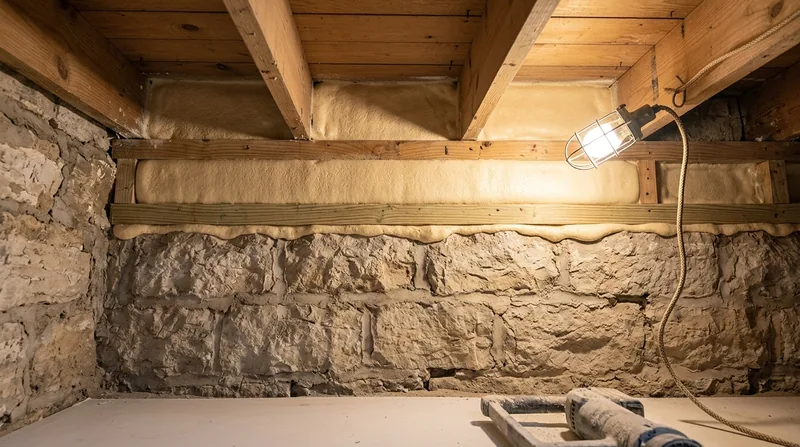




Closed cell spray foam insulation in Lexington delivers rigid, high-density protection where moisture and temperature swings demand it most. Across the Bluegrass, older homes near downtown and the University of Kentucky sit on limestone foundations and crawl spaces that absorb humid air after summer storms, while newer construction in Hamburg and Masterson Station brings taller roof lines and bonus rooms over garages that need air barriers matched to zone 4A's seasonal push-pull. Closed cell foam adds structural strength to rim joists in 1920s bungalows, seals basement walls against limestone seepage, and controls condensation on metal building skins where open cell cannot. We've been installing this foam since 2009, and we know when it's the right answer and when it isn't. Call (859) 309-7396 for a free estimate with R-value and thickness specs, or learn more about attic spray foam insulation if your roof deck needs venting.
Why Closed Cell Spray Foam Matters in Lexington's Mixed-Humid Climate
Lexington sits in IECC climate zone 4A, where hot, humid summers drive moisture inward through walls and ceilings, and cold winters reverse that drive and pull it back out. This seasonal swing is relentless. Rim joists on pre-1980 homes absorb ground moisture; crawl spaces on limestone stay damp for days after rain; and garage walls exposed to outside air lose heat fast once December hits. Closed cell foam stops that two-way moisture migration because it is a vapor barrier itself. Its rigid structure also braces rim joists that have settled or cracked, and it will not sag or compress over decades the way fiberglass does.
- Closed cell foam is impermeable to water vapor, so it works on basement and crawl space walls where humidity is the failure mode.
- It adds structural rigidity to rim joists and band joists, which is critical on 1920s and 1950s homes where the band is the only connection between foundation and frame.
- Closed cell delivers high R-value per inch, typically 6.0 to 7.0 per inch, so you get full coverage in tight spaces without thick buildup.
- It cures to a hard shell that resists impact and vibration, making it the choice for metal buildings and pole barns where condensation control is non-negotiable.
- The closed cell matrix blocks air movement, so you get air sealing and insulation in one pass, with no thermal bridging through studs or joists.
These properties make closed cell the workhorse for moisture-prone and load-bearing applications across Greater Lexington and the surrounding horse farm country.
Key info: Limestone foundations and crawl spaces in Jessamine, Scott, and Bourbon counties retain ground moisture year-round. A closed cell seal on the walls and rim joists stops that seepage from reaching the frame, reducing mold risk and keeping heating and cooling costs down. We inspect the substrate first and walk away if standing water or active leaks are present.
For more on how to choose between closed cell and open cell, see our guide to open cell spray foam insulation. You can also check the Kentucky Building Code through your local building department or the International Code Council for thermal barrier and ignition barrier requirements that apply to your address.
How We Install Closed Cell Spray Foam in Lexington Basements, Crawl Spaces, and Rim Joists
Closed cell installation starts with inspection and prep. We check for active moisture, leaks, or contamination. If the surface is wet or compromised, we do not spray. Once the substrate is dry and clean, we mask off areas that need protection, verify drum temperature and pump ratio with the manufacturer spec, and stage mechanical ventilation so fumes clear during cure. Each pass is sprayed to the thickness and density the job calls for, never overshooting to save time. After cure (typically 24 to 48 hours), we remove masking and inspect for voids or thin spots.
- We inspect the substrate and document moisture or damage before any foam is sprayed, because a bad surface leads to poor adhesion.
- We stage mechanical ventilation during application and cure, so off-gassing does not accumulate in the home or create a re-entry hazard.
- We spray in controlled passes to the thickness your job needs, following the manufacturer drum temperature and ratio protocol exactly.
- We verify R-value and thickness on your estimate and document it in writing, so you know what you paid for and what you got.
- We seal the rim joist perimeter and air-seal gaps around rim and band joists, so you get the air barrier that fiberglass alone cannot deliver.
This discipline is what separates a lasting installation from a job that fails in five years.
Local example: A 1950s brick ranch in Versailles with a poured basement and no rim joist insulation loses heat fast every winter. The band joist is exposed to outside air on the exterior, and the basement stays cold. We spray 2 inches of closed cell on the rim and band joists, plus 1.5 inches on the basement perimeter wall up to grade. Cost is around $1,200 to $1,600 for the rim and band, and the basement temperature stabilizes within a week. The homeowner saves 10 to 15 percent on heating over the season.
Learn more about rim joist and band joist spray foam or crawl space spray foam insulation for detailed guidance on those applications.
Closed Cell Spray Foam Applications and Methods in Lexington
| Application | Thickness & Density | Best For |
|---|---|---|
| Rim and band joist seal | 1.5 to 2.5 inches at 2.0 to 2.2 lbs/cu ft | 1920s to 1970s homes with exposed band joists and cold basements; adds structural bracing and stops air infiltration |
| Basement perimeter wall | 1.5 to 3 inches at 2.0 to 2.2 lbs/cu ft | Poured concrete or block walls on limestone; vapor barrier stops ground moisture and stabilizes basement temperature |
| Crawl space walls and rim | 2 to 3 inches at 2.0 to 2.2 lbs/cu ft | Damp crawl spaces in Jessamine and Scott counties; seals moisture intrusion and reduces mold risk |
| Metal building and pole barn walls | 2 to 4 inches at 2.0 to 2.2 lbs/cu ft | Condensation control on steel skins; rigid closed cell stops moisture from forming on the inside surface |
| Exterior wall retrofit (injection into existing cavities) | Cavity-fill at 2.0 to 2.2 lbs/cu ft | Pre-1980 homes with hollow walls; fills cavities without demolition and adds air seal and moisture barrier |
| Sealed roof deck (unvented attic) | 4 to 6 inches at 2.0 to 2.2 lbs/cu ft | Bonus rooms over garages and cathedral ceilings; rigid closed cell adds rafter bracing and controls moisture in the roof cavity |
Closed Cell Spray Foam Insulation Cost in Lexington: What to Expect
Closed cell spray foam costs typically start at $1.20 per board foot in Lexington, with most residential jobs falling between $1.20 and $1.60 per board foot depending on application, access, and volume. A rim joist and band joist seal on a 1,500-square-foot ranch might run 150 to 200 board feet and cost $180 to $320. A basement perimeter wall on a 1,200-square-foot home could be 400 to 600 board feet and land between $480 and $960. Metal building and pole barn work scales by square footage of wall and roof, and crawl space jobs depend on how many linear feet of wall and joist need coverage.
The main factors that move the price are substrate condition (wet or dirty surfaces require cleaning or drying first), access difficulty (tight crawl spaces or confined attics take longer), volume (smaller jobs have higher per-board-foot costs because setup and travel are fixed), and location within Lexington (jobs in Winchester or Danville may carry a modest travel fee if they fall outside our primary service zone). Get a free written estimate with R-value and thickness specs so you know exactly what you are paying for. We also recommend getting 2 to 3 estimates from other local contractors so you can compare scope, materials, and price side by side.
For a full breakdown of pricing across all our services, see our pricing page.
Closed Cell Spray Foam Insulation Near Me: What Lexington Homeowners Should Know Before Hiring
Finding a spray foam contractor you can trust means verifying insurance, asking for references, and understanding what permits apply at your address. Lexington and surrounding cities each have their own building codes and contractor registration rules, so there is no one-size-fits-all checklist. Here is what to look for when vetting any spray foam installer, including us.
- Ask for proof of current general liability and property damage insurance, and verify the policy with the insurer directly if the amount seems low.
- Request at least three references from jobs completed in the last two years in Lexington or nearby towns like Georgetown, Nicholasville, or Winchester.
- Get a written estimate that names the R-value, thickness in inches, and total board feet so you can compare apples to apples with other quotes.
- Check whether your city or county requires a permit for spray foam insulation by calling your local building department; some do, some do not, and the contractor should help you navigate that, not dodge it.
- If you live in a master-planned community or have an HOA, verify that exterior foam work does not need architectural approval before the job starts.
- Ask the contractor to explain their ventilation plan during cure and the re-entry window (typically 24 to 48 hours); if they promise immediate re-entry, walk away.
A reputable contractor will answer every one of these questions clearly and in writing. If an estimate has no R-value, no thickness spec, and a price far below market, that is a red flag for corner-cutting or inexperience.
Call us at (859) 309-7396 to discuss your project and request a free estimate. We will walk you through the process, explain what applies at your address, and give you a scope and price you can count on.
Closed Cell Spray Foam Insulation in Lexington: Pricing Guide
| Service | Price | Details |
|---|---|---|
| Rim joist and band joist seal | Starting at $1.20/board ft | Typical 150 to 250 board feet per home; 1.5 to 2.5 inches thick; substrate condition and access difficulty affect final cost |
| Basement perimeter wall | Starting at $1.20/board ft | 400 to 800 board feet typical; 1.5 to 3 inches; moisture present or dirty surface requires prep work that increases labor |
| Crawl space walls and rim | Starting at $1.30/board ft | 500 to 1,200 board feet typical; tight access and low headroom increase application time; damp substrate may need drying first |
| Metal building or pole barn walls | Starting at $1.25/board ft | Priced per square foot of wall and roof; condensation control on steel; 2 to 4 inches typical; volume discounts apply to large barns |
| Sealed roof deck or bonus room | Starting at $1.40/board ft | 4 to 6 inches thick; structural rafter bracing adds cost; access and rafter spacing complexity factor into per-board-foot rate |
| Free written estimate | No charge | Response within 24 hours at (859) 309-7396; includes R-value and thickness specs; no obligation to book work |
Indicative pricing, the exact cost depends on square footage, finish, and site access. Free personalized estimate within 24h at (859) 309-7396.


