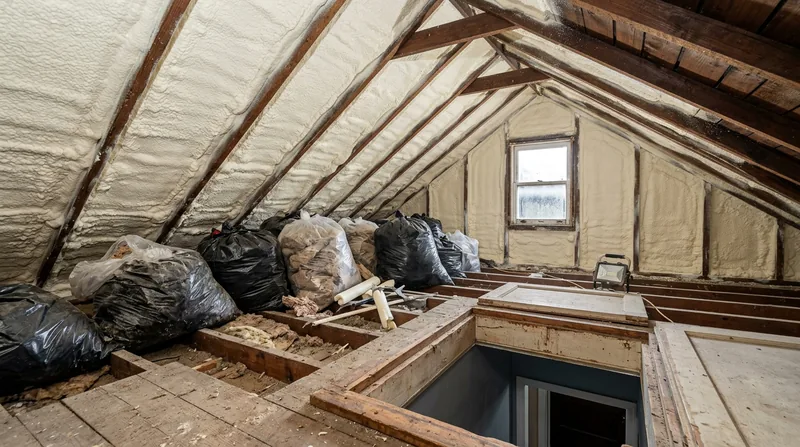




Insulation Replacement & Re-Insulation in Lexington breathes new life into homes that have lost their thermal envelope. Lexington's housing stock, from early 1900s cottages near Chevy Chase and the University of Kentucky to mid-century brick ranches scattered through Hamburg and Masterson Station, carries decades of settling, compressed, or failed insulation that no longer seals against zone 4A's hot humid summers and cold winters. Older attics with thin, degraded fiberglass, uninsulated rim joists, and wall cavities that leak air are the rule, not the exception. The Bluegrass countryside around Nicholasville, Georgetown, and into Jessamine and Scott counties holds farmhouses and barns on limestone with damp crawl spaces and basements that pull moisture inward every summer. When insulation fails, energy bills climb, comfort drops, and the moisture swing that defines this climate, inward in summer, outward in winter, accelerates damage to framing and finishes. We remove old material and install new spray foam sized to your home's framing and the current energy code, restoring the air barrier that keeps your house tight year-round.
Why Insulation Replacement Matters in Lexington's Mixed-Humid Climate
Lexington sits in IECC climate zone 4A, where the seasonal moisture swing is relentless. Summer heat and humidity push moisture inward through walls and ceilings; winter cold reverses that drive and pulls it back out. Homes with original or degraded insulation cannot manage that swing. Attics bake in summer, driving cooling costs up 20 to 40 percent. Poorly sealed rim joists and crawl spaces lose heat fast once cold snaps hit. Thin, settled fiberglass in pre-1980 walls offers little air resistance, and foam that was sprayed without proper ratio, thickness, or curing ventilation can off-gas for months and fail to seal. Replacing failed insulation with properly installed spray foam restores the thermal and air barrier your home needs to survive Lexington's climate.
- Attics with settled fiberglass or cellulose lose R-value and allow hot air to escape in winter and infiltrate in summer.
- Rim joists and band joists around basements and crawl spaces are the thermal weak point of any home and are almost always uninsulated in older Lexington stock.
- Wall cavities in homes built before 1980 typically contain no insulation or low-density fiberglass that compresses over time and creates air paths.
- Crawl spaces under homes near downtown and Hamburg collect moisture that degrades fiberglass and plywood rim boards, accelerating heat loss and mold risk.
- Failed spray foam, installed too thin, at wrong ratio, or without mechanical ventilation during cure, shrinks, cracks, and loses seal, requiring complete removal and replacement.
Replacing worn insulation is not optional in this climate; it is the foundation of comfort and cost control.
Key info: Lexington's building code requires attic ventilation in vented attics and thermal barriers on spray foam (fifteen-minute rating for attics, thirty-minute for walls and crawl spaces). The local building department at your address, whether Lexington-Fayette, Nicholasville, or Georgetown, sets the standard. Always verify what applies before any insulation work begins. See Lexington-Fayette city government for permitting details.
How We Replace and Re-Insulate Homes in Lexington
Replacement insulation starts with removal. We pull old fiberglass, cellulose, or failed foam from attics, walls, crawl spaces, and rim joists using proper containment and disposal. We inspect the substrate for moisture, rot, or active leaks. If the substrate is wet or contaminated, we stop and refer you to the right trade, we do not spray over a leaking roof, standing water, or mold. Once the space is clean and dry, we measure framing depth, R-value requirement, and air-sealing points, then install new spray foam to spec: correct thickness per pass, manufacturer ratio and drum temperature, and mechanical ventilation during cure. We provide a written estimate with R-value and thickness specs so you know exactly what you are buying.
- We inspect the attic or wall cavity for moisture, active leaks, or rot that would prevent foam installation.
- We remove all old insulation, debris, and air barriers using proper containment to protect your home and ductwork.
- We seal air leaks around rim joists, band joists, penetrations, and joist bays before or during foam application.
- We install new open-cell or closed-cell foam to the thickness and R-value your home requires under current code.
- We apply thermal barriers (paint or foam-rated drywall) where code requires, and we document the install with photos and a work order.
- We establish a re-entry window of twenty-four to forty-eight hours and provide clear guidance on ventilation and odor management.
The result is a tight, durable air barrier that lasts decades and performs year-round in Lexington's climate.
Example: A 1960s brick ranch near Hamburg with an original vented attic had settled fiberglass to R-11, no rim joist insulation, and a damp crawl space. We removed the attic fiberglass, sealed the rim joist and crawl space rim board with closed-cell foam, and installed R-38 open-cell in the attic. The homeowner saw a 22 percent reduction in winter heating bills and no condensation on the attic roof deck come spring.
Replacement Insulation Methods for Lexington Homes
| Approach | Description | Best for |
|---|---|---|
| Attic Replacement with Open-Cell Foam | Remove settled fiberglass or cellulose, install 5.5-inch open-cell foam to R-21 or R-38 per code and attic height. | Vented attics in Lexington homes that need cost-effective R-value and sound dampening. |
| Sealed Attic (Unvented Roof Deck) with Closed-Cell Foam | Remove all attic insulation and ventilation. Install 1.5 to 2.5-inch closed-cell foam directly to roof deck, conditioned attic space. | Newer homes with bonus rooms, HVAC equipment, or ducts in the attic; eliminates moisture swing risk. |
| Rim Joist and Crawl Space Replacement | Remove old or no insulation from rim board and band joist. Install 2-inch closed-cell foam to seal and insulate the thermal break. | Basements and crawl spaces in Lexington-area homes on limestone; stops heat loss and moisture infiltration. |
| Wall Cavity Injection Foam Retrofit | Drill small holes in exterior or interior wall, inject closed-cell or open-cell foam into cavities without demolition. | Pre-1980 homes near downtown Lexington and Chevy Chase with no insulation in exterior walls. |
| Garage Ceiling Replacement | Remove old or missing insulation from garage ceiling, install open-cell or closed-cell foam to R-21 or R-30. | Attached garages in Hamburg, Masterson Station, and newer subdivisions; reduces heat loss into living space above. |
| Barn and Metal Building Replacement | Remove old or degraded fiberglass from metal building walls and roof. Install closed-cell foam to control condensation on steel. | Horse barns, shops, and pole buildings on Bluegrass farms; closed-cell prevents condensation drip in humid summers. |
Each method is sized to the framing depth, climate zone, and code requirement at your address. We provide a written estimate with R-value and thickness before we begin.
Insulation Replacement & Re-Insulation Cost in Lexington: What to Expect
Cost for insulation replacement and re-insulation in Lexington ranges from $2,800 for a small attic top-up or rim joist job to $8,000 to $15,000 for a whole-home replacement including attic, rim joist, and crawl space. The main factors that move price are attic square footage, framing height, whether you are replacing in an attic only or adding rim joist and crawl space work, foam type (open-cell or closed-cell), and access difficulty. A 1,200-square-foot attic replacement with R-38 open-cell foam typically runs $4,500 to $6,000. Adding a 400-square-foot rim joist and band joist with closed-cell foam adds $1,800 to $2,400. A damp crawl space requiring moisture control and closed-cell foam insulation runs $3,000 to $5,000 depending on size and substrate condition. We include removal of old material, foam installation, thermal barriers where code requires, and mechanical ventilation during cure in every estimate. Travel is included in Lexington and surrounding areas; there is no separate mileage charge.
The best way to understand cost is to request a free estimate. We measure on site, discuss your climate zone and code requirements, and provide a written quote with R-value and thickness specs so you know exactly what you are paying for. We respond within 24 hours at (859) 309-7396.
What to Look for When Hiring a Spray Foam Insulation Contractor Near Me in Lexington
Hiring the right contractor for insulation replacement is a decision that will affect your home's comfort and energy bills for decades. The spray foam trade has both honest local shops and out-of-state rig-and-run operations that spray a job in an afternoon and disappear. The difference is accountability, technique, and transparency. When you interview a contractor, ask for a written estimate that includes R-value and thickness specs for every section of the work. If an estimate is vague, has no R-value, or quotes a price far below market with no inspection, walk away. Verify that the contractor carries full insurance and ask for a certificate of insurance naming your address. Check references from jobs done in the past two years in Lexington, Nicholasville, Georgetown, or nearby towns. Ask whether the contractor has handled moisture issues or failed foam removal before, and listen for honest answers about when to walk away. Confirm that mechanical ventilation will run during foam cure and that the re-entry window is twenty-four to forty-eight hours, not same-day. Ask about thermal barriers and whether the local building code requires them at your address. If your home is in a master-planned community or HOA, check whether exterior work or attic vents require architectural approval. Most insulation work does not require a building permit, but some attic vents or sealed attic conversions do in some Lexington neighborhoods. Ask the contractor to help you navigate what applies at your address, and always verify with the local building department yourself.
- Request a written estimate with R-value, thickness, and square footage for every section of the job.
- Verify the contractor carries full insurance and ask for a certificate of insurance before work begins.
- Ask for references from homes in Lexington completed in the past two years and call at least two.
- Confirm that mechanical ventilation will run during foam cure and that re-entry is not promised before twenty-four hours.
- Ask whether the contractor will remove failed foam or compromised substrate, and listen for an honest answer about when to stop and refer out.
- Verify what permits or thermal barriers apply at your address by checking with the local building department, not just the contractor.
A local contractor with a local address, local plates, and a track record in Lexington is your best hedge against the national franchises and the out-of-state crews that disappear when the smell does not go away. Contact us for a free estimate and references from Lexington-area homes we have re-insulated.
Insulation Replacement & Re-Insulation in Lexington: Pricing Guide
| Service | Price | Details |
|---|---|---|
| Attic Replacement with Open-Cell Foam | Starting at $2,800 | Removal of old fiberglass, R-21 to R-38 open-cell foam install; price varies by attic square footage and framing height |
| Rim Joist and Band Joist Insulation | Starting at $1,800 | Closed-cell foam on rim board, basement or crawl space perimeter; cost scales with linear footage and crawl space access |
| Whole-Home Replacement (Attic, Rim Joist, Crawl Space) | Starting at $7,500 | Complete air-sealing package for homes 1,500 to 2,000 square feet; includes removal, foam install, thermal barriers, and ventilation |
| Wall Cavity Injection Retrofit | Starting at $3,200 | Closed-cell foam injected into exterior walls without demolition; cost depends on wall area and cavity condition |
| Metal Building or Barn Insulation Replacement | On estimate | Closed-cell foam on steel framing requires on-site measurement; condensation control and ventilation design are custom to each structure |
| Free Estimate | No obligation | Written quote with R-value and thickness specs provided within 24 hours; call (859) 309-7396 or use contact form |
Indicative pricing, the exact cost depends on square footage, finish, and site access. Free personalized estimate within 24h at (859) 309-7396.


