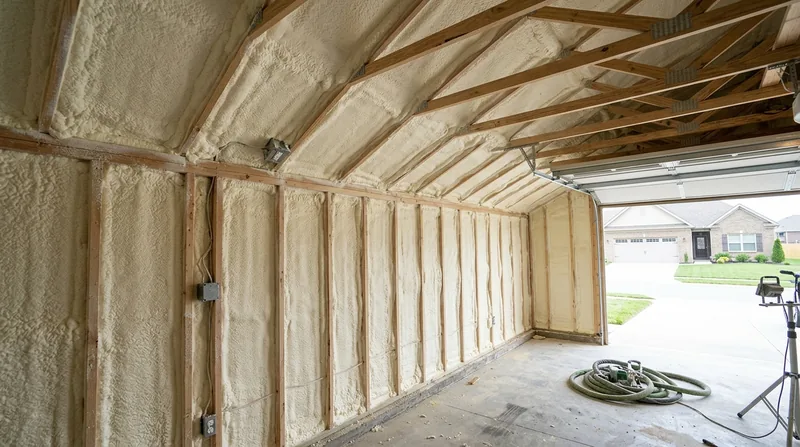




Garages and bonus rooms above them bake in Lexington's humid summers and chill fast in winter cold. Garage spray foam insulation in Lexington stops that thermal swing before it drains your energy bills and makes those spaces miserable to use. New subdivisions toward Hamburg and Masterson Station are packed with bonus rooms over garages, and older homes scattered through the city often have uninsulated garage ceilings and walls that leak heat and pull in moisture year-round. We spray foam the garage ceiling and walls, tightening the shared boundary to living space above and cutting both the temperature swings and the load on your HVAC system. This is IECC climate zone 4A, mixed-humid: hot humid summers push moisture inward through walls and ceilings, while cold winters reverse that drive and pull moisture back out. A properly sealed and insulated garage ceiling stops that swing cold. Air sealing around the spray foam locks down the rest of the envelope and keeps conditioned air where it belongs.
Why Garage Spray Foam Insulation Matters in Lexington-Fayette Urban County Subdivisions
Bonus rooms over garages are a selling point in newer subdivisions, but they are also thermal disasters without proper insulation. The garage below stays unheated or poorly heated, and the ceiling between that cold space and the room above becomes a direct path for heat loss in winter and heat gain in summer. Lexington's humidity and temperature swings mean that an uninsulated garage ceiling also becomes a moisture highway, pulling humid air up into the room above and creating condensation on walls and windows. Spray foam seals and insulates that ceiling in a single pass, stopping the air leakage and the moisture drive before they take hold.
- An uninsulated garage ceiling loses 25 to 40 percent of the heating and cooling energy meant for the room above.
- Spray foam adheres directly to the underside of the roof deck or ceiling joists, creating an air and moisture barrier without gaps.
- Closed cell foam on garage ceilings resists moisture and adds structural rigidity to the framing.
- Open cell foam on garage walls and ceilings is less dense, costs less, and still meets code thermal and fire requirements.
- The shared wall between garage and living space also seals with foam, stopping drafts and noise from the garage into bedrooms or hallways.
A properly insulated garage ceiling and walls make the bonus room usable year-round and stop the energy bleed into an unheated space below.
Key info: Lexington building code requires a thermal barrier between the garage and living space, and spray foam meets that requirement when installed at the correct thickness. Your local building department sets the exact R-value and thermal barrier spec for your address. We help you understand what applies and verify it during the estimate.
How We Spray Foam a Garage Ceiling and Walls in Lexington-Fayette Urban County Homes
The process starts with a walk-through to measure the ceiling area, assess the framing and any existing insulation, and identify rim joists or wall cavities that also need sealing. We confirm the local code requirements for your address, including the thermal barrier thickness and R-value. On spray day, we set up mechanical ventilation to manage fumes during application, protect floors and contents, and spray the foam in thin, even passes to reach the specified thickness. After curing, we inspect the coverage, verify the thickness with a probe, and document the work with photos and a written report.
- We schedule a free estimate and walk the garage to measure the ceiling and walls, check framing and existing insulation, and confirm local code requirements.
- We provide a written estimate with the R-value, foam thickness in inches, and the total board feet needed for your garage.
- On spray day, we set up mechanical ventilation, protect contents and flooring, and spray the foam in controlled passes to the specified thickness.
- After cure time, we inspect coverage and thickness, then document the completed work with photos and a job report.
- We leave behind a written record of R-value and thickness so you have proof of the work for your records or future sale.
The entire process is clean, contained, and documented so you have full confidence in what was done and why.
Example: A 500-square-foot bonus room over a garage in a Hamburg subdivision needs an R-21 garage ceiling to meet code. We spray 3.5 inches of open cell foam on the underside of the roof deck and the top plate wall, creating an air-tight seal and meeting the thermal requirement. The shared wall between garage and bedroom also gets sealed, stopping the draft and the sound of a car door slamming at 6 a.m.
Garage Spray Foam Methods: Ceiling, Walls, and Shared Boundaries
| Method | Description | Best for |
|---|---|---|
| Closed Cell on Garage Ceiling | Dense, rigid foam sprayed 2 to 3.5 inches thick on underside of roof deck, R-6 to R-21 depending on thickness, resists moisture and adds structural bracing. | Garages in humid climates or with moisture risk, bonus rooms needing maximum R-value in minimal space, older garages with roof leaks or condensation history. |
| Open Cell on Garage Ceiling | Softer, less dense foam sprayed 5 to 6 inches thick on underside of roof deck, R-18 to R-21, lower cost than closed cell, still air-tight and meets code thermal barrier. | New construction and newer subdivisions, budget-conscious retrofits, garages without moisture history, bonus rooms where headroom allows 5 to 6 inches of depth. |
| Closed Cell on Shared Walls | Dense foam sprayed 2 to 3 inches thick in the cavity between garage and living space, seals air leakage and stops moisture and noise transmission. | Bonus rooms over garages, bedrooms adjacent to garages, shared walls where sound and thermal isolation are priorities, older homes with thin or missing cavity insulation. |
| Rim Joist Sealing | Closed cell foam sprayed 2 to 3 inches on the top of the rim joist where garage meets the foundation, seals the perimeter and stops heat loss and moisture entry at the base of the wall. | Attached garages with uninsulated rim joists, homes in Lexington-Fayette with limestone foundations and moisture history, garages where the rim is accessible and visible from below. |
Garage Spray Foam Insulation Cost in Lexington-Fayette Urban County: What to Expect
Garage spray foam costs depend on the ceiling area, the foam type (open cell or closed cell), the R-value required by code, and the framing condition. A typical 500-square-foot garage ceiling with open cell foam to R-18 or R-21 starts around $1,500 to $2,200. Closed cell foam, which reaches higher R-values in less thickness, costs more per board foot but may cost less overall if headroom is tight. Adding the shared wall between garage and living space, or sealing rim joists, adds to the total. Access, framing obstructions, and the need for insulation removal if old material is present also affect the price. The best way to know your cost is to get a written estimate with R-value and thickness clearly stated, so you are comparing the same scope across contractors.
We provide a free estimate within 24 hours at (859) 309-7396. Our estimate includes the square footage, foam type, R-value, thickness in inches, total board feet, and the cost. We also explain what local code requires at your address and what that means for your ceiling. See our full pricing overview for typical ranges and what drives the cost up or down.
Garage Spray Foam Insulation Near Me: What Lexington-Fayette Urban County Homeowners Should Know When Hiring a Contractor
Spray foam is a specialized trade, and the difference between a careful installation and a rushed one shows up immediately in odor, curing time, and long-term performance. When you are comparing contractors for garage spray foam, ask for proof of full insurance coverage, request references from recent jobs in Lexington, and verify that the contractor understands local code requirements for your address. A quality estimate includes the R-value and thickness in writing, not just a price. Avoid any contractor who promises immediate re-entry or who cannot explain why mechanical ventilation during spray matters. Ask whether they pull permits if your local building department requires them, and confirm that they will inspect and document the foam thickness after cure so you have proof of the work.
- Verify that the contractor is fully insured and can provide a current certificate of insurance before work starts.
- Request at least two references from homeowners in Lexington who had garage ceilings or bonus room insulation sprayed in the past 12 months.
- Get a written estimate that names the foam type, R-value, thickness in inches, and the total board feet, so you are comparing identical scope across contractors.
- Confirm that the contractor uses mechanical ventilation during spray and respects a re-entry window of 24 to 48 hours before the space is safe to occupy.
- Ask whether permits are required by your local building department for spray foam work and whether the contractor helps you navigate that process.
- Verify that the contractor will inspect the foam thickness after cure and provide a photo or written record so you have proof of the installation.
A contractor who is transparent about insurance, code, and documentation is the one worth hiring. Contact us for a free estimate and we will walk you through the process and answer every question you have about your garage.
Garage Spray Foam Insulation in Lexington: Pricing Guide
| Service | Price | Details |
|---|---|---|
| Open Cell Garage Ceiling | Starting at $1,500 | 500 sq ft ceiling sprayed 5 to 6 inches for R-18 to R-21, includes mechanical ventilation and thickness documentation |
| Closed Cell Garage Ceiling | Starting at $2,000 | 500 sq ft ceiling sprayed 2.5 to 3.5 inches for R-15 to R-21, moisture-resistant, includes inspection and written thickness report |
| Shared Garage Wall Sealing | Starting at $800 | Cavity between garage and living space sealed with closed cell foam, stops air leakage and noise transmission, typical 200 to 300 sq ft |
| Garage Rim Joist Sealing | Starting at $600 | Rim joist perimeter sealed with closed cell foam, stops heat loss and moisture at foundation line, typical 150 to 200 linear feet |
| Complete Garage Package | On estimate | Ceiling, shared wall, and rim joist sealed in one project; scope and framing condition determine final cost; free written estimate within 24 hours |
| Estimate and Travel | Free | No obligation, response within 24 hours across Lexington and surrounding areas, call (859) 309-7396 |
Indicative pricing, the exact cost depends on square footage, finish, and site access. Free personalized estimate within 24h at (859) 309-7396.


