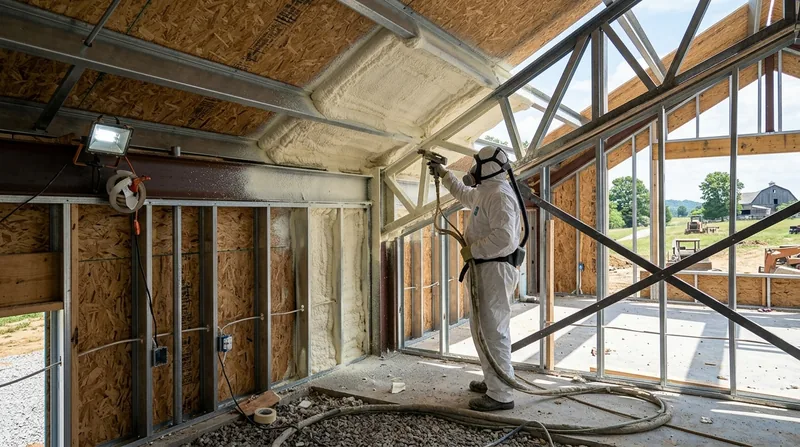




New construction around Lexington keeps adding roofs and wall cavities that need an air barrier. From the newer subdivisions pushing toward Hamburg and Masterson Station to the growing commercial corridors in Nicholasville and Georgetown, builders are closing in roof decks and walls faster than ever. Commercial and new construction spray foam insulation is the standard way to seal those cavities before drywall goes up, and it works because spray foam expands to fill every gap and creates a continuous air barrier that fiberglass batts and blown-in cannot match. In this mixed-humid climate zone, summer heat and humidity drive moisture inward through walls and roof decks, while winter cold reverses that load. A sealed, unvented attic or a foam-filled wall cavity stays dry and conditioned year-round. We work with builders and general contractors across Fayette and Scott counties to spray foam new roof sheathing, walls, and crawl spaces before the framing is closed in, on the schedule the builder sets.
Why New Construction Spray Foam Matters in Lexington-Fayette Urban County
Lexington-Fayette is in the middle of a construction cycle. Bonus rooms over garages, taller roof lines, and new commercial shells are being framed every week, and every one of those roofs and walls is an air-sealing decision. A vented attic or an uninsulated rim joist in a new house will perform just as poorly as an old one, and the homeowner or tenant will live with those costs for thirty years. Spray foam applied during framing eliminates the thermal bridge that happens when insulation is stuffed between studs or joists after the air barrier has already failed. In this climate, where summer cooling and winter heating both drive moisture, a sealed roof deck or sealed wall cavity stays stable and dry.
- We spray foam new roof decks before sheathing and membrane to create an unvented attic that stays dry and conditioned year-round.
- Wall cavities are foamed during framing to seal every stud cavity and rim before drywall closes them in.
- Crawl spaces in new construction are foamed and sealed to prevent the moisture buildup that limestone soils and spring runoff bring to Fayette County basements and crawl spaces.
- Garage ceilings and band joists are foamed to prevent thermal loss and condensation on the rim where the foundation meets the floor system.
Spray foam applied at framing stage is faster and cleaner than any retrofit, and it means the builder stays on schedule while the home gets a true air barrier from day one.
Key info: Kentucky building code requires that spray foam be covered by a thermal barrier (drywall, OSB, or other approved material) within fifteen minutes of application in most occupancies. This is the rule that separates a professional installation from a shortcut. We apply foam and install temporary barriers on the same day so your framing crew can drywall the next morning without delay. Your local building department will inspect before closing, and we coordinate that timing.
For more detail on the air-sealing principles that make new construction spray foam effective, see our air sealing page.
How We Work with Builders and GCs in Lexington-Fayette Urban County
Our process is built around your schedule, not ours. We coordinate with your framing crew and your building department to spray foam on a day that keeps your job moving. We show up with the rig, confirm the substrate is clean and dry, mix the foam to manufacturer spec, and spray to the thickness and R-value your plans call for. Once the foam cures, we install temporary barriers where code requires them, and your drywall crew comes in the next day. We handle the paperwork and inspection coordination so you do not have to chase the building department.
- We review your plans and the local code requirements at your address to confirm thickness, R-value, and barrier requirements before we show up.
- On the day of spray, we confirm the substrate is clean, dry, and at the right temperature for the foam system you have specified.
- We spray to the thickness and coverage your estimate calls for, using a pump calibrated to the manufacturer ratio and drum temperature.
- We provide a written record of board-foot coverage, thickness, R-value, and the date of application for your building file.
- We coordinate the thermal barrier installation and communicate with your building department on inspection timing.
This approach keeps your framing schedule intact and ensures the foam system meets code and performance spec from the first day of occupancy.
Example: A new office building in Georgetown needed a sealed roof deck and closed-cell foam in the crawl space to keep the structure dry and conditioned. We coordinated with the GC to spray the roof deck on a Monday after framing was complete, installed temporary barriers on Tuesday, and the roofer was on the job Wednesday. The crawl space was foamed the same week. No delays, no re-scheduling, and the building passed inspection on the first attempt.
To understand the difference between closed-cell and open-cell spray foam for your specific application, see our closed-cell spray foam page.
Spray Foam Methods for New Construction
| Approach | Description | Best for |
|---|---|---|
| Closed-Cell Spray Foam | High-density foam with a closed-cell structure, typically 2 to 3 pounds per cubic foot. R-value around 6 to 7 per inch. Resists moisture and air infiltration. Cures rigid and can be left exposed in some applications. | Sealed roof decks, crawl spaces, rim and band joists, and any cavity where moisture control is critical. |
| Open-Cell Spray Foam | Lower-density foam with an open-cell structure, typically 0.5 pounds per cubic foot. R-value around 3.6 per inch. Breathes and allows moisture to pass through. Cures soft and requires a thermal barrier. | Wall cavities and attics where cost efficiency and sound dampening matter more than vapor resistance. |
| Rim and Band Joist Sealing | Closed-cell foam applied to the rim joist and band joist to seal the thermal bridge between the foundation and the floor system. Typically 2 to 4 inches of spray foam, depending on code and design R-value. | All new construction in Lexington, especially homes on basements or crawl spaces where the rim joist is exposed to exterior air. |
| Crawl Space Encapsulation with Foam | Closed-cell foam applied to the rim joist and band, plus foam or closed-cell spray on the crawl space walls and floor perimeter. Creates a sealed, conditioned crawl space that resists moisture from limestone soil and spring runoff. | New construction crawl spaces in Fayette, Jessamine, and Scott counties where moisture control and foundation health are priorities. |
Commercial and New Construction Spray Foam Cost in Lexington-Fayette Urban County: What to Expect
Spray foam pricing for new construction is driven by three main factors: the square footage of the area being foamed, the thickness and R-value required by your plans and code, and the type of foam (closed-cell or open-cell). A typical new roof deck or crawl space encapsulation runs anywhere from a few hundred dollars for a small addition to several thousand for a full commercial shell. The best way to get a realistic number is a free commercial estimate on site, where we can see the framing, confirm the substrate is ready, and give you a board-foot count and a firm price.
Factors that affect cost include the height and complexity of the roof (a two-story ranch roof is simpler than a commercial building with multiple roof levels), the size of the crawl space, access for the spray rig, and whether you need temporary barriers installed the same day. We do not charge by the board foot in advance; we measure on site, confirm the thickness and R-value with you, and provide a written estimate with all the details.
For a detailed pricing breakdown and to see the range of jobs we handle, visit our pricing page. Call us at (859) 309-7396 to schedule your free commercial estimate.
What to Look for When Hiring a Spray Foam Contractor Near Lexington-Fayette Urban County
Not all spray foam installers are equal. The difference between a professional installation and a shortcut is visible in the estimate itself. A real estimate includes the R-value per inch, the thickness in inches, the total board-foot coverage, and the date of application. It also names the foam system (closed-cell or open-cell, and the manufacturer), specifies the drum temperature and pump ratio, and confirms that mechanical ventilation will be used during cure. If an estimate does not include these details, or if it promises immediate re-entry or a price far below market, that is a red flag.
- Verify that the contractor is fully insured and can provide a certificate of insurance before work begins.
- Ask for written estimates from at least two contractors so you can compare R-value, thickness, and price side by side.
- Check whether the contractor coordinates with your local building department and understands the thermal barrier rule and ventilation requirements at your address.
- Confirm that the contractor will provide a written record of the installation, including board-foot coverage, thickness, R-value, and the date, for your building file.
- Ask about the re-entry window after spray; the honest answer is twenty-four to forty-eight hours with proper ventilation, not same-day occupancy.
Getting multiple estimates and asking these questions is the best way to protect yourself and ensure your new construction gets the air barrier it deserves. Contact us for your free commercial estimate and to ask any questions about how we work.
Commercial & New Construction Spray Foam in Lexington: Pricing Guide
| Service | Price | Details |
|---|---|---|
| Free commercial estimate | Free | On-site measure, R-value and thickness spec, board-foot count, and written quote with no obligation to book |
| Sealed roof deck (new construction) | From $0.60/board foot | Closed-cell or open-cell foam, thickness per code, temporary barrier installation, inspection coordination included |
| Crawl space encapsulation (new construction) | From $0.55/board foot | Closed-cell foam on rim joist and perimeter walls, moisture barrier, sealing of all rim penetrations and rim details |
| Wall cavity spray foam (new construction) | From $0.45/board foot | Open-cell or closed-cell foam, all stud cavities sealed, band joist included, thermal barrier installed same day |
| Large commercial or complex project | On estimate | Multiple roof levels, large crawl spaces, or mixed foam systems require site review and detailed specifications |
| Travel and coordination | Included | No mileage fee or travel charge in Lexington and surrounding service areas, including Georgetown, Nicholasville, and Winchester |
Indicative pricing, the exact cost depends on square footage, finish, and site access. Free personalized estimate within 24h at (859) 309-7396.


