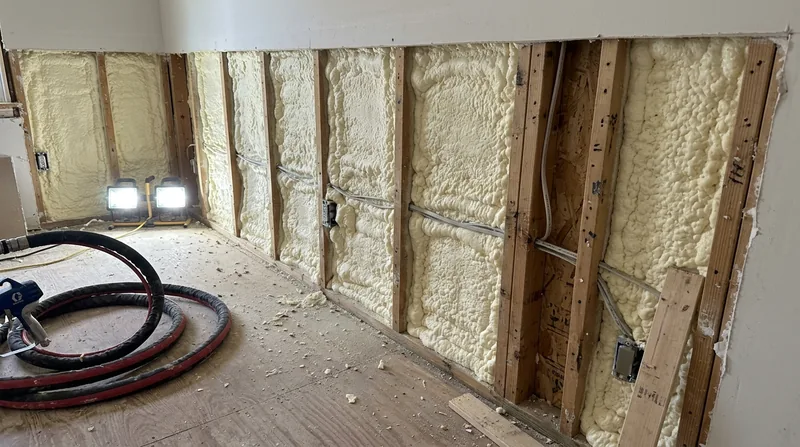




Open cell spray foam insulation fills wall cavities and attic spaces in Lexington homes with a soft, expanding layer that conforms to irregular stud bays and rafter lines. In mid-century brick ranches scattered across the city and newer subdivisions toward Masterson Station, open cell foam delivers sound dampening and thermal control without the density or cost of closed cell alternatives. Lexington's climate, hot humid summers that drive moisture inward through walls and ceilings, then cold winters that reverse that pressure, demands an air barrier that breathes and flexes with seasonal swings. Open cell foam handles that job well in interior walls and attic spaces where vapor permeability is an asset rather than a liability. We have been installing spray foam insulation since 2009, and we know which product fits which wall and which attic in this region. Call (859) 309-7396 for a free estimate, or read on to understand why open cell foam makes sense for your home.
Why Open Cell Spray Foam Matters in Lexington-Fayette Urban County Homes
Lexington sits in IECC climate zone 4A, mixed-humid, where attics bake in summer and poorly sealed rim joists bleed heat in winter. Open cell foam expands to fill voids that traditional fiberglass batts leave behind, cutting air leakage at the source. Older homes near the university and in neighborhoods like Chevy Chase and Ashland Park often have vented attics with thin, settled insulation; open cell retrofit over those cavities adds R-value and stops air movement without tearing out existing material. Newer homes with bonus rooms over garages or taller roof lines benefit from open cell in wall cavities where sound control and interior thermal resistance matter more than vapor impermeability.
- Open cell foam expands to fill irregular stud bays and rafter cavities that batts cannot seal.
- The material is permeable to water vapor, which allows walls to dry if moisture does enter during seasonal pressure swings.
- Sound absorption is inherent to the structure, reducing noise transmission between rooms and from exterior sources.
- Installation does not require removal of existing insulation when used as a top-up in attics with sound framing.
- Cost per board foot is lower than closed cell, making it the practical choice for interior applications where R-value per inch is not the limiting factor.
These advantages make open cell the right choice for many Lexington homes, especially when the goal is air sealing and interior comfort rather than vapor barrier performance. Learn more about attic spray foam insulation to see how this product fits into a complete insulation strategy.
Key info: Lexington's limestone terrain and high water table mean crawl spaces and basements stay damp long after heavy rain. Open cell foam in attics works best when rim joists and band joists are sealed separately, often with closed cell, which resists moisture better in below-grade zones. We assess your whole home and recommend the right product for each zone.
How We Install Open Cell Spray Foam Insulation in Lexington-Fayette Urban County
Every open cell spray foam job starts with a site inspection and a written estimate that names the R-value and thickness we will achieve. We verify attic framing, check for moisture or roof leaks, and confirm that the substrate is dry and sound. If we find a wet or compromised surface, we walk away, fixing the moisture source comes first, always. Once the site is ready, we set up mechanical ventilation to manage fumes during application and establish a re-entry window of 24 to 48 hours.
- We inspect the attic or wall cavity and verify that all roof leaks and moisture issues are resolved before foam is sprayed.
- We set up containment and mechanical ventilation to control odor and off-gassing during the application and cure.
- We spray open cell foam in multiple thin passes, maintaining the manufacturer's drum temperature and mixing ratio to ensure proper expansion and adhesion.
- We trim excess foam flush with the framing and install thermal and ignition barriers as required by your local building code.
- We document the R-value achieved, thickness in each zone, and the date of installation on a label left in your attic or wall cavity.
This process takes one to two days for a typical attic retrofit, depending on square footage and framing complexity. Our crew remains on site until cure is complete, and we provide written guidance on re-entry timing and ventilation requirements.
Example: A 1,200-square-foot attic in a mid-century ranch in the Masterson Station area with existing fiberglass batts typically receives 4 to 6 inches of open cell foam, raising the effective R-value from R-19 to approximately R-38 to R-50, depending on existing depth and cavity fill. The job takes one day, and the home is ready for normal use after 24 to 48 hours.
For more detail on air sealing alongside insulation, see our air sealing service page.
| Approach | Description | Best for |
|---|---|---|
| Attic Top-Up | 2 to 6 inches of open cell foam sprayed over existing batts or blown-in insulation. | Homes with settled or thin attic insulation, sound framing, and no active moisture or leaks. |
| Wall Cavity Fill | Open cell foam injected or sprayed into stud bays of interior walls for sound control and thermal resistance. | Interior partition walls, bonus rooms, and new construction where vapor permeability is acceptable. |
| Sealed Attic (Conditioned) | Full-depth open cell foam in rafter bays to create an unvented, conditioned attic space. | Homes where attic space is finished or will be used for storage; requires thermal and ignition barriers per code. |
| Retrofit Over Removal | Complete removal of failed or contaminated insulation, followed by open cell spray foam application. | Attics with settled fiberglass, old blown-in mineral wool, or previous foam that has degraded or absorbed moisture. |
Open Cell Spray Foam Insulation Cost in Lexington-Fayette Urban County: What to Expect
Open cell spray foam is priced by the board foot on site after measurement. A typical attic top-up in Lexington starts around $0.55 per board foot, but the final cost depends on several factors. Attic size and complexity, existing insulation depth, roof pitch, and accessibility all affect the total. A 1,200-square-foot attic with 4 to 6 inches of foam typically runs $1,500 to $3,500, depending on those variables. Wall cavity fill and retrofit jobs over removed insulation carry similar per-board-foot rates but require site inspection to confirm scope.
Getting two or three estimates from different contractors is the only way to understand what the market will charge for your specific home. Each estimate should include R-value, thickness in each zone, and a breakdown of how the board footage was calculated. Avoid any estimate that omits those details or quotes a flat price per square foot without measuring the cavity depth.
Our pricing page provides starting points and ranges for different applications. Call (859) 309-7396 for a free, no-obligation estimate with written specifications.
What to Look for When Hiring a Spray Foam Insulation Contractor Near Lexington-Fayette Urban County
The spray foam market includes rig-and-run crews that arrive in an out-of-state trailer, spray a job in an afternoon, and vanish when the odor lingers or the foam shrinks. It also includes national franchises that subcontract work to local installers with varying skill and accountability. A local independent contractor with a Lexington address, local plates, and a decade in the market offers a different value: you can reach us when questions arise, and we stand behind our work because we live here.
When evaluating any contractor, including ours, verify the following.
- Confirm the contractor is fully insured and ask to see a current certificate of insurance listing your address as an additional insured.
- Request references from jobs completed in the last two years and call at least two to ask about odor, cure time, and whether the contractor was reachable after the job.
- Ask for a written estimate that names R-value, thickness, and board footage, never accept a price quote without those specs.
- Verify that the contractor understands your local building code, including thermal barrier and ignition barrier requirements for your zip code.
- Check whether your HOA has architectural rules that govern exterior work or material choices; some master-planned areas in Lexington restrict foam visibility on metal buildings or barns.
- Ask whether the contractor will handle permitting and code compliance or whether you will be responsible for pulling permits at your city building department.
A contractor who answers these questions clearly and provides written documentation is one you can trust. Contact us to discuss your project and get a free estimate with full specifications.
Open Cell Spray Foam Insulation in Lexington: Pricing Guide
| Service | Price | Details |
|---|---|---|
| Attic Top-Up (4-6 inches) | Starting at $0.55/board ft | 2 to 6 inches of open cell foam over existing insulation; cost rises with attic size and roof pitch complexity |
| Wall Cavity Fill (Interior) | Starting at $0.55/board ft | Open cell foam injected into stud bays for sound and thermal control; price depends on wall length and cavity depth |
| Sealed Attic (Conditioned) | Starting at $0.65/board ft | Full-depth rafter cavity fill with thermal and ignition barriers; higher cost reflects barrier materials and code compliance |
| Insulation Removal and Foam Retrofit | On estimate | Complete tearout of failed insulation plus open cell spray requires site inspection to confirm volume and disposal scope |
| Travel and Setup | Included | No mileage fee or travel charge within Lexington and surrounding service area |
| Free Estimate | Free | Written specifications with R-value and thickness, response within 24 hours at (859) 309-7396, no obligation to book |
Indicative pricing, the exact cost depends on square footage, finish, and site access. Free personalized estimate within 24h at (859) 309-7396.


